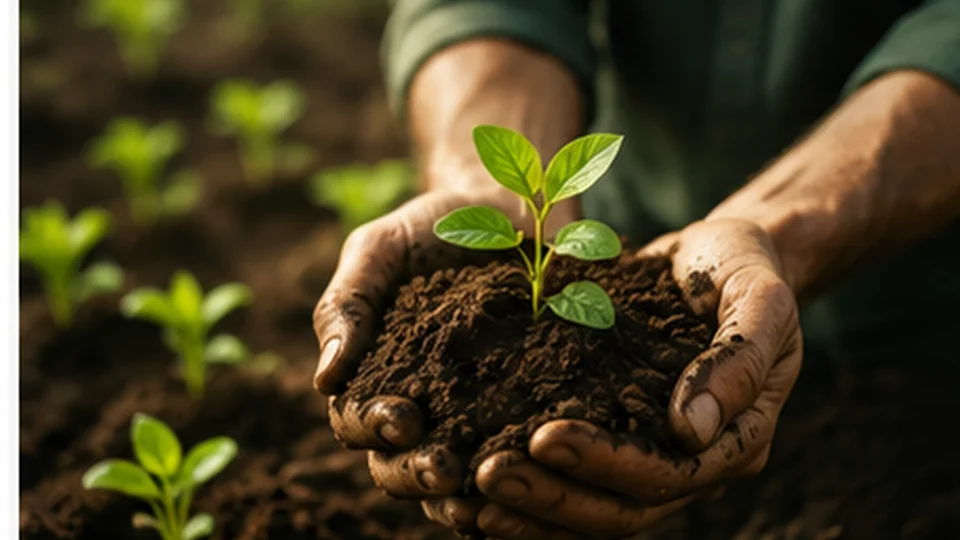
Healthy soil is more than a place to hold roots. It is a living system that stores and moves water, cycles nutrients, supports organisms, anchors plants and helps buffer environmental stress. Strong crop performance begins below the surface, which is why soil health is best understood as the continued capacity of soil to function as a living ecosystem—not as a single fertilizer value or one season’s yield.
What soil health means
The USDA Natural Resources Conservation Service defines soil health as the continued capacity of soil to function as a vital living ecosystem that sustains plants, animals and people. That definition matters because it shifts attention away from treating soil as an inert growing medium. Healthy soil contains a complex food web of bacteria, fungi and other organisms interacting with plant roots, minerals, air and water.
1. Five important jobs healthy soil performs
Regulates water
Soil influences whether rainfall and irrigation infiltrate, move through the profile or run off the surface.
Cycles nutrients
Nutrients such as carbon, nitrogen and phosphorus are stored and transformed through soil processes.
Supports life
Roots and soil organisms depend on pore space, moisture, food sources and a suitable chemical environment.
Filters & buffers
Minerals and microbes can help retain, transform or break down some materials moving through soil.
A fifth function is physical support: soil structure provides the medium in which roots can anchor and explore. Good structure helps create a balance between solid particles and pore spaces for air and water.
2. Four management principles that build soil function
NRCS soil-health guidance organizes management around four broad principles: maximize living roots, minimize disturbance, maximize soil cover and maximize biodiversity. These principles are not a rigid recipe; they are a framework for keeping the soil food web supplied and the soil surface protected.
Keep living roots for longer
Living roots feed the rhizosphere—the biologically active zone immediately around roots—through compounds released by plants.
Disturb soil only as much as necessary
Repeated or intensive disturbance can break down structure and organic matter and can reduce the habitat available to soil organisms.
Protect the surface
Crop residues or cover can reduce raindrop impact, conserve moisture, moderate temperature and reduce erosion risk.
Increase diversity
Diverse rotations and plant communities can support a wider range of roots, residues and soil organisms.
3. Why soil organic matter matters
Organic matter influences many physical, chemical and biological properties of soil. NRCS notes that management practices such as diverse rotations, cover crops and reduced tillage can help increase organic matter over time. As structure improves, water infiltration can increase and runoff can decrease; nutrient storage and biological activity can also improve.
Organic matter should not be viewed as a quick input with an instant result. Changes depend on soil type, climate, cropping system and management history. Building soil function is usually a long-term process that benefits from repeated, consistent management.
Healthy soil can make water more useful.
Better aggregation, pore space and organic matter can support infiltration and water retention, helping crops access moisture more effectively between rainfall or irrigation events.
4. Soil health is assessed with indicators, not one number
NRCS emphasizes that soil health cannot be measured directly with a single test. Instead, farmers and advisers evaluate indicators that reflect physical, chemical and biological conditions. Useful indicators can include soil organic matter, infiltration, bulk density, structure, water-holding characteristics, pH, electrical conductivity, nitrate, phosphorus, potassium, earthworms, microbial biomass and soil respiration.
The right indicators depend on the management question. A field with poor drainage, for example, may require attention to structure, compaction and infiltration, while a nutrient-management question may require pH and nutrient testing. Comparing the same field over time can be more informative than chasing a universal “perfect” number.
5. A practical soil-health approach
Good soil management begins with observation and baseline information. Walk the field after rain. Look for runoff, crusting, ponding, compaction, erosion and root restrictions. Examine soil structure and rooting depth. Combine visual observations with appropriate soil testing and keep records of what changes after management adjustments.
The practical takeaway
Stronger crops are supported by a soil system that can hold roots, move water, cycle nutrients and sustain biological activity. Practices that protect the surface, reduce unnecessary disturbance, maintain living roots and increase diversity can help improve soil function over time.
Long-term production starts below every crop.
A sustainability-focused farm strategy is stronger when soil condition is treated as part of production planning—not only as a problem to address after yields decline.
Research references
This article summarizes authoritative agricultural guidance in plain language. The source links below are provided for deeper reading.
Field conditions differ by location, crop, soil, weather and production system. Use local agronomic advice and appropriate testing before making crop-specific input or treatment decisions.